We asked Robin Miller, IMPACT Demonstrators Lead, and Sarah McLoughlin, our Strategic Improvement Coach, to reflect on 2022 and the Demonstrator project so far. Our Demonstrator is taking place in Northern Ireland, and is looking at ‘asset-based approaches’, and how older people can have a better life via health and social services working in new ways with them, the community, and the voluntary sector.
What have been your wins/highlights of 2022?
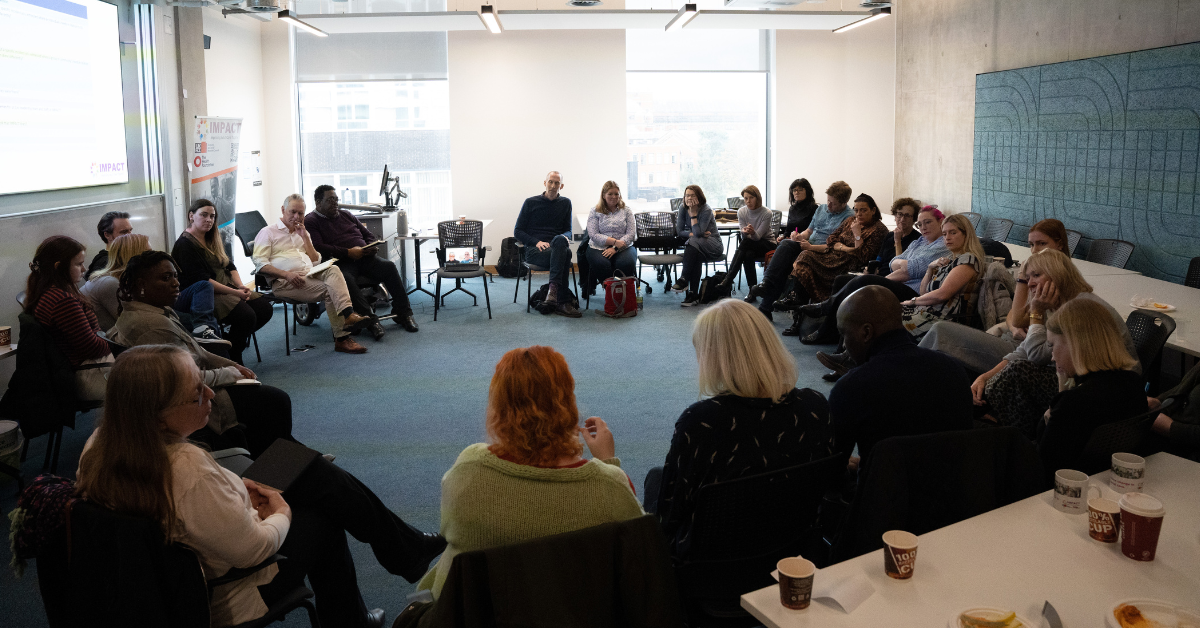
The potential value that can be generated through IMPACT partnering with an innovative local area to learn from their experiences and support them to build on their strengths. Mid & East Antrim has been a great place for the Demonstrator model to be piloted due to MEAAP’s established networks with older people and with policy and practice partners. Our World Café stakeholder event was an excellent reflection of this – 50 people with lived experience and/or professionals coming together to discuss, debate and design.
How have your aspirations for the project/IMPACT changed?
The overall aspirations for the project – understanding how to engage all of the relevant stakeholders in a local area with innovation, identifying what the important elements of an asset-based approach in primary and social care – remain the same. Through the gathering of lived, practice and research evidence the opportunities to support improvement have become clearer though, for example in relation to responding to the different expectations of diverse communities and demonstrating to professionals how the approach can save them time as well as benefit older people and their families.
What have you learned so far?
When planning future Demonstrators, it will be important that there is a good level of commitment from across the social and health care system, and a local organisation who is well connected and willing to lead on the process in this area.
There are relatively few people with all the knowledge and skills necessary to undertake a strategic improvement role in social care – therefore part of the role of IMPACT needs to be on workforce development and building a cadre of people with these skills.
What are your hopes for next year?
Apart from the very practical hope that our second Improvement Coach is appointed, we want to take forward the actions that are set out in the theory of change regarding increasing the spread and further strengthening the depth of this asset-based approach. We would also hope for policy makers in Northern Ireland to learn from our experience in Mid and East Antrim as they develop the integrated care system.
What’s unique about your ‘asset-based approaches’ project?
The strength of connection with older people in the local area, the high level of commitment from stakeholders, and the capacity building activities with the voluntary and community sector.
Any highlights, stories, or surprises you’d like to share?
The World Café event we ran in November, and feedback from older people and wider stakeholders is a great example of the project’s impact to date.
Earlier this year, IMPACT’s Co-production Advisory Group had the pleasure of meeting and engaging with The Health Foundation Inclusion Panel. This created an opportunity for IMPACT to focus on building relationships between organisations. Early in the process we agreed this would be a two-way engagement and we would focus on the theme of co-production. The detail of what that would look like took a little longer to decide.
Co-producing an event
We agreed to co-produce the preparation and delivery of our co-production themed event, involving two members of each group plus the coordinator of each group. Narrowing down such a big topic is challenging – it can be time consuming and a little messy, but this is time well spent. As co-production means different things to different people, it involves accommodation and relationship building, seeing things from alternative perspectives and not being prescriptive. Not being prescriptive means that it can take time to tease out the theme and agree on questions to address and perhaps working in a way that’s different from what we are used to.
Happy to say I’m quite reassured it’s come a long way. I didn’t think you would get there, well done guys! Testament to real coproduction in action.
Isaac Samuels, member of the Co-production Advisory Group
Building relationships for a successful approach
Cohesiveness, trust, and building relationships takes time for groups. This applies internally to groups and in external engagement. This is an ongoing challenge when time to co-produce, plan and deliver is limited or restricted by the reality of projects and work programmes.
A takeaway for me was the importance of building relationships to ensure effective co-production.
Ann Marie Penman, member of the Co-production Advisory Group
As a fledgling group meeting, engaging, sharing and learning with an established group was insightful. We are at different points in our journeys – we are starting out on our journey and the Health Foundation Inclusion Panel is working out its path for a sustainable and productive future. The experience of meeting a more established group reinforced the point that relationships, group trust and dynamic takes time to build. The sense of family and community from the well-established Health Foundation Inclusion Panel was palpable. This was inspiring and settled us as a group that we are right to spend time on building relationships and trust within our group.
In the practical sense, the process of co-producing the joint event has prompted us to try this approach in our preparation and meeting delivery. Until this point, we were somewhat self-critical of our own approach – a ‘knowing’ that we weren’t quite there but not quite sure how to get where we want to be.
Reflections
I am very proud of our work as the Co-production Advisory Group in 2022, particularly our ability and willingness as a group to be flexible, listen to each other, to feedback and most importantly to act upon it. Building relationships involves building trust and confidence. This takes time. A key takeaway from this meeting is co-producing the preparation, delivery and follow up. We are implementing this approach in our workplan for 2023.
Karen McCormick, Lived Experience Engagement Lead
My own reflections were about how important it is to consider the whole process in effective co-production. That is, thinking about before, during and after i.e. how do we make sure we give the opportunity of involvement to everyone, how do we bring people together in a suitable space (physical and otherwise) and how are people kept involved and updated afterwards? A lot of our discussions focused on the being together part, but I think it’s important not to lose site of the ‘before’ and ‘after’.
Ann Marie Penman, member of the Co-production Advisory Group
Relationship building extends beyond the relationship between two groups. Bringing in another group can somewhat shift the dynamic within our own groups. Sharing lived experiences and a passion for co-production with another group was empowering for members of IMPACT’s Co-production Advisory Group, a sense of shared purpose, a healthy respect and acknowledgement of the perspective of others.
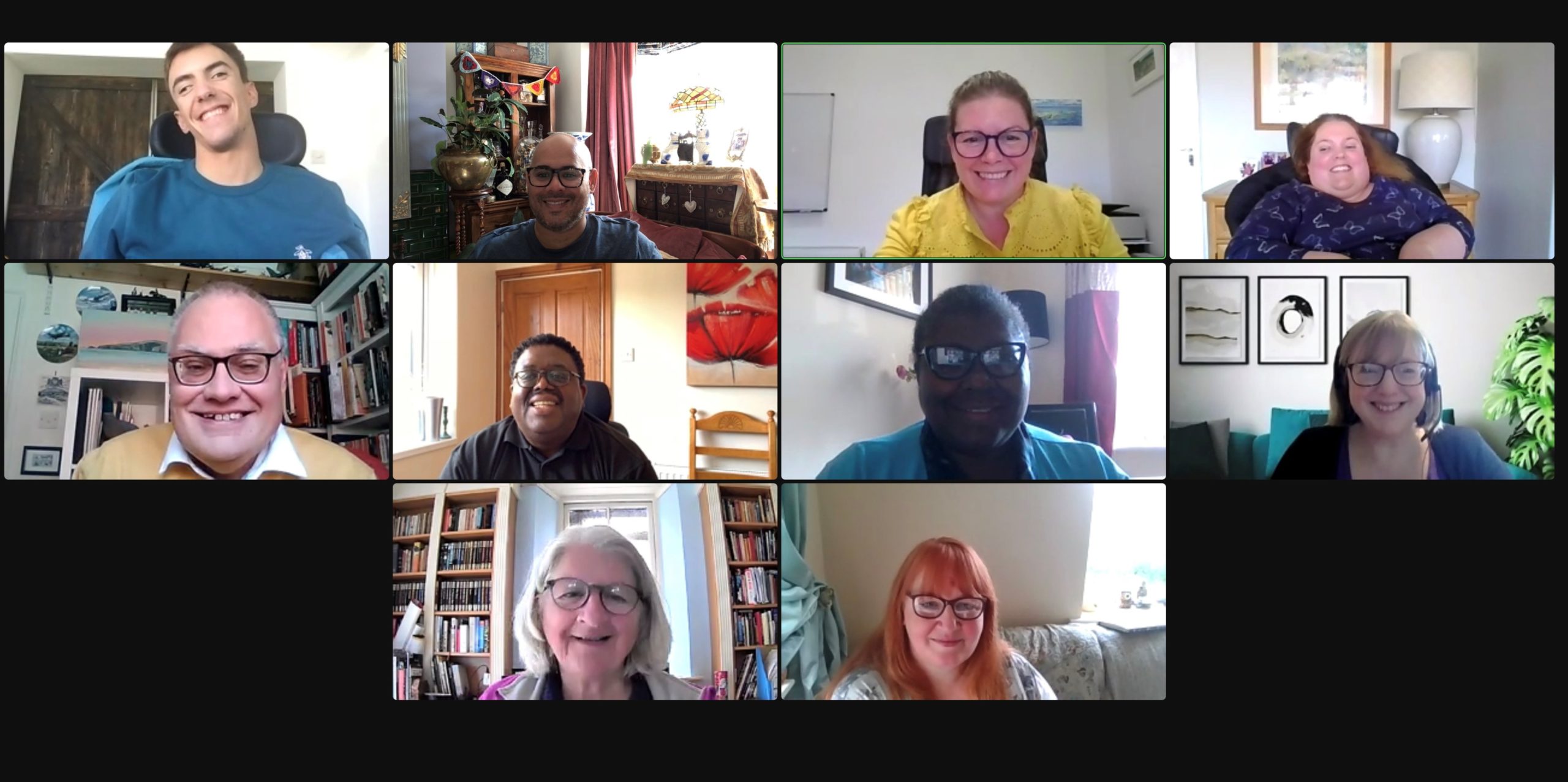
We asked members of the Co-production Advisory Group, to reflect on the year, and the work of the group so far. Scroll through to read reflections from Karen McCormick (Lived Experience Engagement Lead), and Ann Marie Penman who co-designed and co-facilitated the last Co-production Advisory Group meeting of 2022.
Karen McCormick’s Reflections
Our Co-production Advisory Group has been given the freedom this year to co-design and co-develop our way of working (Charter), our workplan and how we will meet strategic objectives. This approach has been a breath of fresh air. However, it is not without challenge. There is a fine line between coordinating, supporting, and delivering for the group and the project but in a way that is not prescriptive.
We created a reflections document, which collates the sentiments, thoughts, and ideas of group members. Starting from “you said”, we move towards the outcomes we want to achieve and some actions that we can either take as a group or put forward to other team members in IMPACT that may be helpful in delivering the outcomes.
We have a number of priorities for 2023, including: establishing and embedding two-way communications with and across IMPACT, continuing to identify the skills and assets of the group and expand our engagement offering, and establishing a feedback loop.
Thoughts from Ann Marie Penman
It seems to me that we’ve come a really long way. We’ve come together from across four nations, with different backgrounds, experiences, skills, and opinions but with a shared belief in the value of co-production to make things better.
It’s been a really steep learning curve, in terms of getting to know each other, the wider work of IMPACT and what our role is and might be.
Our remit is very broad, but there are three key aspects:
develop, support, monitor and review IMPACT’s co-production activity
produce an annual report
identify areas of good practice and areas for development
In our first year, it feels like we’ve had an inward focus, quite rightly looking at us as a group and what we bring, our strengths and our assets. As well as that, we’ve been exploring and gathering more information on the wider work of IMPACT.
Each time we’ve met, we have raised questions, made observations, picked up issues and contributed comments – and it’s all of these that have been gathered together into our reflections document. Essentially, it’s giving us a direction for our second year. It’s clear in these recommendations that it’s still important that we continue getting to know each other better but there’s also now an increased emphasis on our personal development, for each one of us. What is the benefit for any one of us in being part of this group?
And there is a clearer balance now in terms of what we want to be bringing to the wider work of IMPACT – what difference do we make, what value do we add and how are things better because of us, the Co-production Advisory Group?
The reflections document is our own development plan. It’s what we’ve come up with ourselves in terms of what is important for us but also recommendations for the IMPACT Leadership Team, for all the different IMPACT projects and the whole organisation.
I think it’s important to remember this is a living document. It will grow and develop each time we meet as we go through the next year. We can add to it, change it and further develop it but also what we want to do is think about, for each recommendation, what is the outcome that we want to put forward as the Co-Production Advisory Group, what will be better and specifically what is the benefit and for who?
A paper setting out a framework for collaboration between NIHR Health and Social Care Delivery Research (HSDR) and IMPACT was discussed at the HSDR Programme Oversight Committee in April 2022. The principles for closer working to promote and enhance social care research were welcomed by the HSDR Programme Director and committee. The Committee endorsed the approach, setting out how this informal collaboration might work and key touchpoints where there would be mutual benefit in close working to maximise HSDR outputs and reach wider social care audiences. This was seen as an exciting opportunity for the Programme.
It was agreed that information on current studies in the pipeline could be shared regularly with Jon Glasby and staff at IMPACT, perhaps on a quarterly basis. It was suggested that pilot work would be done with early engagement with teams and projects on linked studies on family group conferencing and support for people with learning disabilities/autism leaving long-stay hospitals which are likely to be of great interest to social care practitioners and service users.
Jon Glasby is also linked into other parts of NIHR, including the School for Social Care Research, Research for Social Care programme and the NIHR Centre for Engagement and Dissemination. Developing ways of working with HSDR programme may be a useful pilot arrangement which could be the model for other parts of NIHR.
This paper was then discussed at the IMPACT Leadership Team meeting in June 2022. With a few minor changes in wording or emphasis, IMPACT would be keen to pursue all the opportunities below as a way of supporting NIHR as it extends its social care expertise and presence, and as a way of supporting a number of IMPACT’s key objectives.
Frameworks for working with NIHR
Background
IMPACT is the UK centre funded by the ESRC and Health Foundation to implement evidence in adult social care. Following a scoping phase with surveys and Assemblies to identify pressing topics and ways of working, the new centre will enter a steady state for five years from 2023-27. After this, the aspiration is that the centre, or key elements of its work, becomes a more permanent feature of the social care landscape (future business model tbc).
NIHR Health and Social Care Delivery Research (HSDR) Programme is a national funding programme awarding more than £20m a year for research on the quality and organisation of services in health and social care. Projects relevant to social care range from evidence synthesis on strengths-based approaches to social work to ambitious evaluations of family group conferences for vulnerable adults.
Suggested areas for joint working and synergy
Anticipating research pipeline and maximising funded outputs
HSDR has a number of projects underway in the area of adult social care. This includes £7m+ investment in local adult social care research partnerships around the country, projects on self-neglect, care workforce and support for older carers. In the first instance, this could be a pilot for one or two research teams and projects to work with IMPACT, with IMPACT delivery staff working to implement findings from these studies. This would need to depend on their being an appropriate ‘fit’ between forthcoming research and IMPACT’s priorities for 2023-25 (to be submitted to IMPACT’s funders in September 2022). NIHR studies would also need to be working with a similar definition of evidence (which IMPACT defines in terms of insights from different types of research, the lived experience of people drawing on care and support and carers, and the practice knowledge of social care staff).
Identifying gaps/research needs
IMPACT’s broad and deep engagement will help to identify priority areas for future research. This is already evident from outputs from the survey/Assemblies which highlighted the importance of research in areas like prevention and wellbeing, asset-based approaches, carers’ health and wellbeing, and support for people who work in social care. Having chosen a series of key topics for its forthcoming work programme, IMPACT also goes through a ‘triage’ process to make sure that there is enough evidence with which to work, and checking for gaps – in either research, lived experience or practice knowledge. HSDR could work with IMPACT and constituent partners to work up briefs in priority areas, identifying important areas of research interest and important gaps in knowledge and framing calls in ways that will resonate with social care researchers and communities.
Building capacity and sharing expertise
Consider opportunities to develop and strengthen capacity and community in adult social care research. Some approaches for embedded research and capacity building are being tested in the new HSDR adult social care partnership research awards, as well as particular opportunities through NIHR Academy Incubator for Social Care. There may be other opportunities – for instance, shadowing or sharing resources around review and research methods through the rapid evaluation and synthesis centres. This is a key priority for IMPACT as one of its four objectives is around building capacity in the workforce, and there may be scope to explore for IMPACT to support the local stakeholders with whom it is working on the ground to encourage stronger applications for existing NIHR capacity building schemes and helping to create a pipeline of credible candidates for these opportunities.
HSDR would also benefit from the expertise and networks of IMPACT to strengthen funding committee and reviewer base to make the right decisions with the right expertise for new projects.
Next steps
IMPACT and HSDR Programme staff to meet to take forward above areas for development – with quarterly meetings suggested going forwards
There is a particular opportunity to build in 1-2 topics from current NIHR projects into the draft work programme which IMPACT submits to funders in September 2022
IMPACT and HSDR to explore scope to publish a statement about this relationship/ways of working
It has been a busy few months for IMPACT with all of our projects up and running, and the team travelling from across the four nations to Birmingham, to meet for an Equality, Diversity and Inclusion training day, facilitated by Clenton Farquharson and Luke Geoghegan from our Leadership Team.
Amongst all of the busy, hard work, there has also been good news across IMPACT we’d like to share.
IMPACTAgewell, who are hosting our Demonstrator project, won the Best Health Creating Population Health Management Approach award, at the UK Excellence in Health Creation Awards.
IMPACT’s Director, Jon Glasby, joined the Scottish Parliamentary Committee on Health, Social Care and Sport to provide evidence on the National Care Service (Scotland) Bill. You can watch the session back here.
Subscribe to our newsletter to be amongst the first to hear of news and updates.
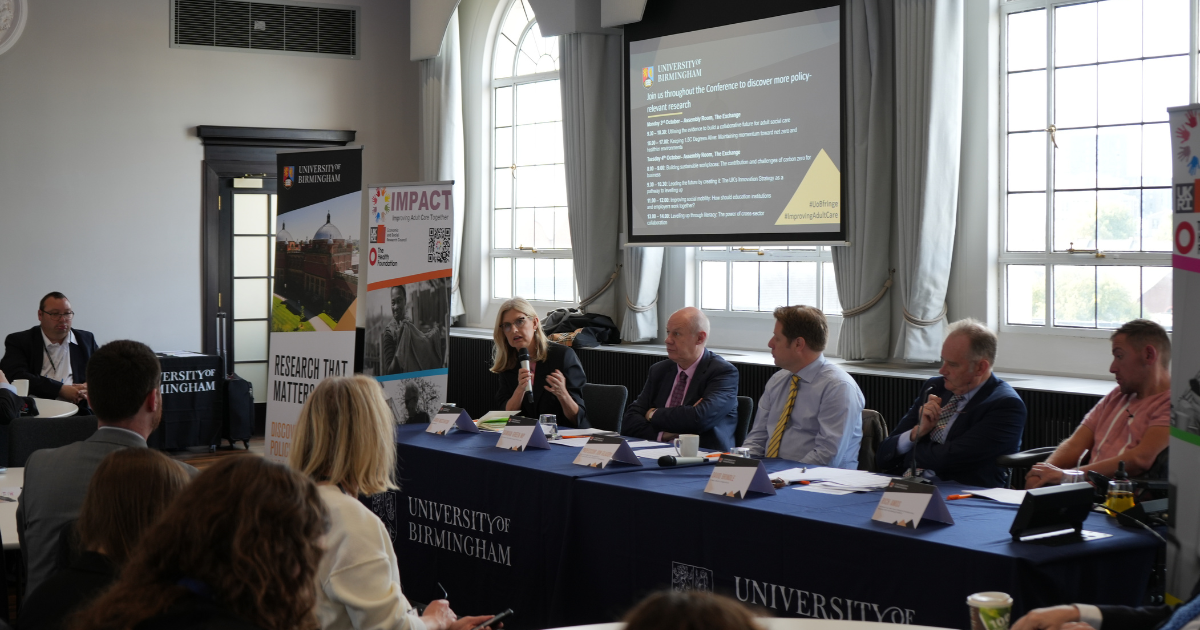
On Monday 3 October, IMPACT hosted a Conservative Party Conference fringe event in Birmingham city centre: ‘Utilising the Evidence to Build a Collaborative Future for Adult Social Care’.
The panel was made up of:
Jon Glasby, Director of IMPACT and Professor of Health and Social Care at the University of Birmingham
Damian Green MP, Co-Chair of the APPG on adult social care and MP for Ashford
Sarah McClinton, ADASS President and Director of Health and Adult Services and Deputy Chief Executive for the Royal Borough of Greenwich
Ruch Amos, self-described “average guy who has a passion for reducing inequalities for disabled people”
David Brindle (Chair), senior commentator and ex-Guardian Public Services Editor
Learning from lived experience
The panel was focused on how we can promote good practice, scale up, aid innovation and remove the barriers. The discussion started with Rich’s lived experience of adult social care, emphasising the importance of having a network of friends and the effect of changes to funding – after moving into local authority accommodation, individual care budgets were replaced by collective ones.
“Funding was only available for us to exist.”
Rich Amos
He reflected that there was a real lack of attention to individual support needs and was told his housemates should be his source of social interaction. He and his housemates were treated as one unit, not individuals. Rich has now moved to a different local authority, where he was reassessed and it was recognised he needed one to one support, which he now receives through PAs supporting him 24 hours a day.
The challenges
“The overwhelming barrier is the lack of capacity.”
Damian Green
Damian Green emphasised workforce provision and a lack of smooth planning as significant issues – constituents have told him that care home space is available, but it’s very hard to get domiciliary care. He said a lack of organisation, paired with a need for more funding, means innovation in social care is hampered.
Sarah McClinton said it’s important to reflect on the breadth of care, with over half a million people waiting for social care right now. She also said crises feed into short-termism, and longer-term planning is challenging.
Jon Glasby called for adult social care to be reframed nationally, with care seen as able to change lives. At the moment, there’s a lack of visibility: challenges are not well-understood by the public and policy-makers, and social care is portrayed as a burden. He added that people feel policy claims what they should be doing but the question is how do we do this for real? IMPACT’s co-design survey found people want more practical support, rather than evidence.
Rich Amos emphasised the external factors that are playing a part in challenges finding accessible accommodation, from Covid to the lack of accessible new build properties. He said the system needs to be more flexible and adaptable, and that we’ll keep having these conversations unless learnings are shared and the system changes.
Opportunities for change
Damian Green said we need to change planning rules, so a percentage is set aside for accessible housing/housing for those drawing on social care. He said it could make a radical difference, challenging the crisis narrative if care was embedded in people’s lives and routines. He also emphasised the possibilities an imaginative use of assistive technology could open up.
Sarah McClinton agreed, emphasising the control these changes could give people. She said we will all need housing that lets us be independent for the longer. Discussing the future of the sector, she highlighted: broader housing standards and more flexible approaches. She also suggested more integrated care systems, with more focus on recovery and building independence, as well as learning from COVID (data on support needs/vulnerability presents the possibility to do preventative work).
“Good support isn’t just about ‘services’ – it’s about having a life.”
Jon Glasby
Jon Glasby said you have to start with the person and the life they want to lead, and build back from that – a person-first approach. He added that community navigators and local area coordinators are really valuable, so we need to have creative conversations about what support people need & from whom.
David Brindle asked a quick-fire question. What would you prioritise, to improve adult social care?
Rich Amos: Co-production is key, the benefits are clear. We need a national, universal approach to this instead of pockets of excellence and of fragmentation.
Damian Green: Ending the conception that social care is funded by council tax. It must be funded nationally. We also need a proper workforce plan.
Sarah McClinton: Making the sector more attractive to work in: better pay for the social care workforce, parity with NHS staff, the workforce needs to feel truly valued and that there are career development opportunities
Jon Glasby: Organising care well relies on relationships – building relationships locally with partners, and between central and local partners.
Rich Amos said people must be involved at every step of the journey when designing services, with equal relationships and power dynamics removed to create better outcomes for everyone involved.
Jon Glasby said good leadership is needed at all levels but there’s currently an ambivalent attitude towards leadership across the sector – need to create routes where people can keep doing what they love in their jobs as they move up the career ladder. He added there’s no shared approach and united sense of what success looks like in social care so we end up arguing with ourselves & presenting varied messaging to policymakers.
Sarah McClinton emphasised that work is needed to improve staffing and resourcing, through a workforce plan.
“Adult social care can be very scary for individuals, but we all need to remember the impact it has. We get so focused on policies, agendas, but adult social care comes down to humans supporting each other and if that works well it enables people who draw on care to live fulfilling lives.”
6-week reflection by Amber Cagney, Networks Manager
I’m Amber Cagney – I work part-time with Kate Hamblin (Networks Lead) and Maria Teresa Ferazzoli (Project Officer) on the IMPACT Networks. My role is UK Networks Manager, which includes recruiting Local Network Coordinators across the four nations, supporting them to run their Local Networks and meeting them in between each one to debrief and decide together how to run their next meeting. We’re currently running our first pilot network on choice and control and recruiting sites for the second network pilot on values-basedrecruitment and retention.
I worked in the anti-slavery sector for almost 10 years after starting out as a volunteer! My previous job with West Midlands Anti-Slavery Network was as the development manager where I set up a safe house project for male survivors of modern slavery in a multi-agency partnership. I still work within the sector part-time, and I’m a trustee for a charity delivering long-term support to survivors of modern slavery and human trafficking.
I’ve been with IMPACT for six weeks and am reflecting on the work we’ve done so far.
Equality, Diversity, and Inclusion
Equality, diversity, and inclusion are at the centre of IMPACT’s values. Having come from a human rights background, I believe the Universal Declaration of Human Rights should be central to any work or research into the care and support of people. The Declaration states “All human beings are born free and equal in dignity and rights”, it also states the rights to equal access to public services, the freedom of movement, and many others; these are core principles and it’s essential that our work is grounded in the pursuit of equality for all people to have a good life and the ability to thrive.
Equality is about ensuring that every individual has an equal opportunity to make the most of their lives and talents. It is also the belief that no one should have poorer life chances because of the way they were born, where they come from, what they believe, or whether they have a disability. Equality recognises that historically certain groups of people with protected characteristics, such as race, disability, sex, and sexual orientation, have experienced discrimination.
Multi-agency Interactions
IMPACT’s Networks are a good example of inclusive multi-agency interactions that are exploring the issues related to choice and control and values-based recruitment with a range of individuals who either draw upon care and support or help deliver it. Our first pilot is underway, tasked with exploring mechanisms, systems, and behaviours in adult social care that enable choice and control.
Initial Feedback
The feedback from our first Local Network meetings across England, Scotland, and Wales has been really interesting to read and reflect on so far. The definition of care is “the process of protecting someone and providing what that person needs”. The feedback strongly suggests the shift needs to be in the “process” and ensuring that the person being cared for has a voice, choice, and control in what their care looks like, with the recognition that every person is unique and has their own wants and needs. All individuals who access public services for care have the right to be protected from harm, and the right to be supported to live with as much autonomy and freedom as possible.
Choice and Control in Care
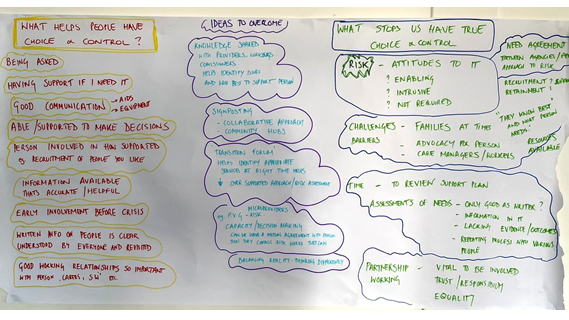
The networks discussed enablers for choice and control in care, which included:
Being asked – sometimes decisions can be made for people. True choice and control means asking, then asking again in the future – not assuming one answer stands forever – and also considering the person’s communication needs.
Being supported to make decisions – decision making can happen at lots of different levels, and people should be supported to make as many decisions as they can, and at every level possible.
Good information – being able to access information on providers, activities, or groups, that is up to date and free from jargon, but also accessible.
Good relationships – there are power dynamics in relationships, about how one person could be seen as being quite influential and pushing a decision in a particular way. Facilitating open conversations is important, potentially using advocacy.
Transparent systems and clarity over budgets– clear understanding of the eligibility criteria for different monies and knowing what they could be spent on
The local network attendees also acknowledged hindrances and barriers to choice and control, including both systemic and human decisions such as:
Risk – people should be supported to take risks and try new things, but attitudes – from the person, their family, support provider, or social worker – can be a hindrance. Proactive risk management with the supported person and mitigating risks together can be positive.
Relationships – sometimes the “family knows best” perspective can be a hindrance to the individual making progress. Also relationships between different partners- care providers feel like they are consulted to a lesser degree than a social worker, for example.
Rigid systems and processes
Time – time to review support plans is not seen as a priority, and choices should be revisited, not taken as permanent.
Location and availability of services – very rural locations mean choices can be limited.
Disconnect between social care and health – health paying directly for some services rather than putting it into the budget so the individual can choose.
Covid-19 – many projects and activities were paused during the COVID-19 pandemic.
Next Steps
The next steps of the Local Networks are to explore what an effective mechanism to enable choice and control with finances and support plans looks like, and to share best practice amongst the different regions
We are currently facing the ongoing challenges of the COVID-19 pandemic, in a complex adult social care environment that is systemically underfunded, undervalued, and neglected in policy; we are very aware of the challenges of creating change, however, to progress and move forward to a more equal society and nation, these are exactly the types of conversations we urgently need to have, and there is no better time than now.
In 2022, we’ve been getting up and running as a national centre and testing our four delivery models via a series of pilot projects across different parts of the UK. In 2023, we want to work in even more places and cover a broader range of topics. We’re still working on the detail of this, but we hope to be able to go out to the sector in late 2022 with an ‘expression of interest’ – looking for partner organisations who might be interested in hosting future projects.
Topics for 2023
The topics for 2023 would be based on the priorities which came out of our national survey and from our Assemblies. In particular, we’ll focus on topics which:
Make a real difference
Tackle inequalities
Make good use of scarce resources
Have enough evidence for us to work with (where there isn’t enough evidence we’re trying to make sure that we feed this back to partner organisations so that they can try to fill these gaps as quickly as possible)
This is likely to include topics such as:
Prevention and well-being
Assets-based and person-centred care
Carers’ health and well-being
Support for people who work in social care
Identifying Partner Organisations
When we identify sites that might want to work with us, we want to get a real mix (e.g. in terms of geography, and the nature and needs of the local population). We also want to make sure that we don’t just work with organisations that usually volunteer for these opportunities – but with a wide range of people. This might include small, innovative community organisations; user- and carer-led organisations; and services that are really struggling and wouldn’t usually be able to think about taking part in something like this.
To help people plan, we’ll be clear about the funding and support we can provide, but also about the things we’ll need in return (for example, we’ll want sites that are committed to co-production and to sharing learning with others).
Expressing interest
There will be more information later in the year – but please start thinking about whether your organisation might be interested in expressing an interest. You can sign up to our newsletter and follow us on social media (Twitter, LinkedIn) to be among the first to find out more.
We’re mid-way through our 2022 Establishment phase, and deep in the middle of setting up pilot projects to test our four delivery models. We are delighted to share that our first IMPACT Network has been set up.
IMPACT Networks are one of the four delivery models IMPACT is piloting to achieve change in adult social care. Our first network is looking at choice and control for people with learning disabilities and/or mental health issues in supported living. Our Network Coordinators are:
Networks are being piloted across the UK, with local networks in Scotland, Wales, Northern Ireland, and England, all focusing on the same issues. The aims are:
To improve practice and outcomes in adult social care at the local level and solve common, yet complex challenges.
To bring together practical solutions at the community level to create solutions that can be scaled up to help inspire and inform change across the UK.
Each local network, made up of 8-10 people – people with experience of care and support, carers, front-line staff, funders/decision-makers, and relevant service providers – will meet four times over a period of six months. They will discuss a particular issue using materials provided in advance, such as findings from research, practice knowledge, and lived experience. Members will share their experiences and learning and suggest practical solutions.
They will feedback to the Networks Lead, Kate Hamblin, and Networks Manager Amber Cagney, and learning will be shared with the other local groups working on the same issues, creating a network of networks. The aim is to produce an action plan to take a particular issue forward and enact change.
The inspiration
IMPACT Networks were inspired by one of our Critical Friends: Nka, the Swedish Family Care Competence Centre. For many years, Nka has worked with ‘Blended Learning Networks’ – a method where people with a common interest and from various backgrounds work towards a common goal. They learn from each other and share experiences and convert research results into practice and policy. The networks always focus on carers, but each local network is based on a specific theme of interest to key stakeholder groups, including informal carers and their organisations
A local network consists of 10-15 people – carers, health and social care practitioners, decision-makers, local politicians – led by one or two members. The leaders of the local networks in turn have meetings with staff from Nka, forming a national network.
We were also inspired by Etienne Wenger, who in the field of education, developed the concept of communities of practice in organisations to solve common issues they were facing. Communities of practice are formed by people who engage in a process of collective learning – they share a concern or passion for something they do and learn how to do it better through regular interaction.
Next step for our Network
The first Network meetings will take place in late July.
Amber Cagney has recently been appointed as the Networks Manager, and will be working closely with Kate. Maria Teresa Ferazzoli has also joined the team in Sheffield recently as the Project Officer. We will update our project page with updates from Kate and the team.
The beginning of the journey of the Co-Production Advisory Group
A key element of IMPACT, the UK evidence centre for adult social care, is the commitment to co-production in all aspects of its work. The first step towards this commitment involved the Co-Production Advisory Group, and their group Charter.
The Co-production Advisory Group’s role is to develop, support, monitor and review IMPACT’s co-production activity, producing an annual report for the Leadership Team on progress made during the year, areas of good practice and areas for further development. This work is supported by the Lived Experience Engagement Lead, Karen McCormick.
“Quite often when new groups come together for the very first time, it can be a challenge to gel. We are all a little bit nervous and perhaps unsure of each other’s circumstances. However, this was not the case with IMPACT’s new Co-Production Advisory Group. They are an animated, confident and lively bunch – this bodes well for us as a group.” Karen explained.
Creating a Charter
A charter is a nice way to document how we intend to collaborate together and our guiding principles. It’s a way of acknowledging the work we have to do, such as project objectives and the parameters we have to work within, but also allowing space for members of the group to have their say on how we approach it and work together.
“My approach to starting a charter is to include the knowns, leaving space for the unknowns and being open to the aspirations.” Karen tells us.
“The knowns are the practical things such as structures, definitions, the fact that we need to have 3 meetings this year and produce and annual report. The unknowns are things like the topics we are going to discuss and the schedule for this. Unknowns are also things like the shared vision for the work of the group, the strengths and assets of the group and the language we use and barriers to participation. Suggestions around practical tips for working together online, communicating and engaging are also included in the early version.
“These were collated into a draft charter (a working document) and presented as suggestions to get us started at the induction meeting – the first coming together of the co-production advisory group – all subject to change through engagement and agreement among members of the group. Ideally with more time, we would come with a blank page but we have a lot of work to do in a short space of time.”
A Living Document
It is intended that the charter will be a living document. Just like charting any course, it will need revision – the group will have waypoints, needing to check where they are and if they are heading in the intended direction. It is hoped that by the end of the first working year together all members of the co-production advisory group respect the journey, and recognise each other and themselves as valued members of the crew.
Like most websites we use cookies to help deliver services and to track how website is performing. We do not use cookies for advertising.
Functional
Always active
The technical storage or access is strictly necessary for the legitimate purpose of enabling the use of a specific service explicitly requested by the subscriber or user, or for the sole purpose of carrying out the transmission of a communication over an electronic communications network.
Preferences
The technical storage or access is necessary for the legitimate purpose of storing preferences that are not requested by the subscriber or user.
Statistics
The technical storage or access that is used exclusively for statistical purposes.The technical storage or access that is used exclusively for anonymous statistical purposes. Without a subpoena, voluntary compliance on the part of your Internet Service Provider, or additional records from a third party, information stored or retrieved for this purpose alone cannot usually be used to identify you.
Marketing
The technical storage or access is required to create user profiles to send advertising, or to track the user on a website or across several websites for similar marketing purposes.