
Welcome to the IMPACT Director’s Update bulletin. Jon Glasby has been the Director of IMPACT since 2021, when the centre officially launched – he is a qualified social worker and Professor of Health and Social Care. This new monthly update will allow Jon, and colleagues across IMPACT, to share key highlights, milestones, and learning.
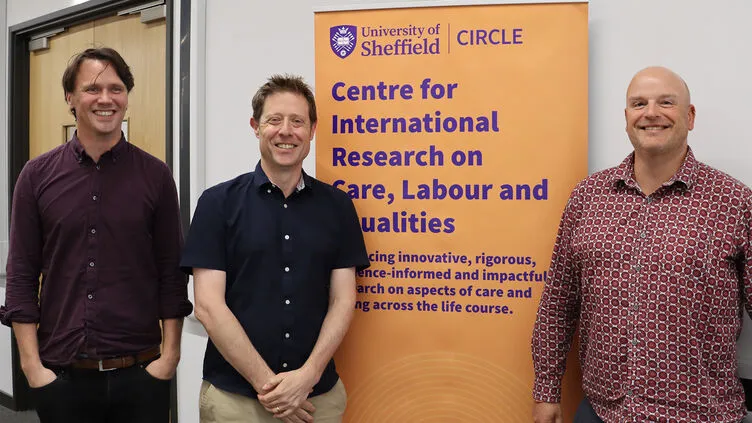
In May, Jon delivered the CIRCLE Annual Lecture 2026, providing an overview of IMPACT’s contribution to social care policy, reflection on the lessons learned, and the importance of getting evidence used in practice.
‘Making an IMPACT’ – getting evidence used in practice
This month, amongst many various travels, I was honoured to be asked to deliver this year’s CIRCLE annual lecture.
CIRCLE is the Centre for International Research on Care, Labour and Equalities at the University of Sheffield, set up 20 years ago by Prof. Sue Yeandle OBE, a founding member of IMPACT and our first Deputy Director.
Alongside its own research on care and caring, it’s a core part of the IMPACT Leadership Team and leads the ESRC Centre for Care (with IMPACT partners such as the University of Birmingham, Carers UK, SCIE, Skills for Care, the Care Workers’ Charity and several other collaborators). It also led the previous ESRC ‘Sustainable Care’ programme, which in many ways was a forerunner to the initial team who came together to bid for what later became IMPACT.
I have an additional personal interest, in that my parents first met as undergraduates in Sheffield in the late 1960s on a combined social sciences programme. My Mum, as a girl growing up in the 1950s, had always been encouraged to do arts and languages, while my Dad, as a boy, had been encouraged towards science and maths. She therefore wanted something that was more like ‘science’, he wanted something that was more ‘social’, and they met in the middle. As a result, Sheffield will always have a place in my heart.
At the lecture, I shared IMPACT’s mission and what it does, but also tried to draw out some of what we’re learning about evidence, co-production, and implementation:
- Some disciplines think that there’s a ‘best way’ of carrying out research (sometimes known as a ‘hierarchy of evidence’) – but we believe that it depends on what you want to know, when deciding the best way to find it out. For us, lived experience, practice knowledge and research are all important ways of knowing the world in their own right – and we need to bring all three forms of expertise together if we’re to make practical progress. Although this sounds like a dry debate around the nature of knowledge, it’s actually an important statement about power – about which voices get heard when we try to improve social care services, and which voices get edited out.
- This makes co-production central to everything we do, and this has to involve power sharing, not just tokenistic attempts at ‘involvement’ or ‘consultation’. We build lived experience into all our work, from our definition of evidence, to our staff team; from our local projects to our national governance. Our Co-production Advisory Group play an additional role in supporting and challenging our thinking and practice, so that we always do our best to live out our values. As a result, co-production isn’t a destination we ever reach, but more of a journey we go on together – it’s more about values, relationships, dialogue, trust and negotiation than it is about specific mechanisms or structures.
- Getting evidence used in practice to make a difference to services and to people’s lives is really difficult, especially in a challenging external environment. Our work is based on practical support in the realities of the workplace to draw down insights from the evidence, and to make practical changes in response – a form of ‘learning by doing’ that seems really effective in social care in particular. This also needs very practical and skilled colleagues, who bring experience in terms of change management, organisational development, coaching, leadership and consultancy – not necessarily some of the skills that some Universities have traditionally valued in their roles and job descriptions. You also need to be flexible, creative, empathetic and resilient in equal measure to be able to take a promising insight, get it implemented in practice, and then persevere in a challenging and ever-changing local context.
For people wanting to be involved in, or tasked with, introducing a local or national change, the lecture finished with IMPACT’s model for leading evidence-informed change – as a way of helping people think through the different things they need to do and structure their work. Anyone who is interested in finding out more can go to the IMPACT website, or join our online ‘community of practice’ group, who are supporting each other as they use the model in practice. Next year, we’ll also be exploring scope for a more formal development programme for people who want some extra support around the evidence-informed changes they’re trying to oversee and champion – so watch this space.
A big thank you to Sheffield colleagues for the invite to speak, and for being such a key part of the IMPACT family (as well as the help they initially provided all those years ago to what later became the Glasby family!
How to stay up to date – follow us!
There’s so much going on at any one time that it can be difficult to keep up with the latest news.
You can sign up on our website for a regular centre-wide update, and you can search our projects and resources by topic, by nation or a series of more cross-cutting themes!
Thank you for reading.
Jon