What happens when people don’t feel safe to be themselves in the very services designed to support them? After watching a ‘script-in-hand performance of At the Rainbow’s End at Birmingham’s Midlands Arts Centre (MAC), IMPACT Director Jon Glasby was left reflecting on the experiences of older LGBTQ+ people in care and support settings, and on why person-centred, inclusive care remains such an important priority in IMPACT’s work, and for the wider social care sector.
As someone who essentially gets paid to write and talk for a living, it’s not often I’m lost for words – but a recent trip to Birmingham’s Midlands Art Centre (MAC) left me struggling to know what to say.
We’d been invited to join a panel for a Q&A after a ‘script-in-hand’ performance of At the Rainbow’s End by Clare Summerskill – stand-up comedian, writer, actress, singer-songwriter, public speaker, oral historian, and freelance academic. Clare, described by Radio 4’s Women’s Hour as “a Lesbian Victoria Wood”, is Artistic Director of Artemis Theatre Company, and the author of an incredibly hard-hitting play, At the Rainbow’s End. As her website describes, it’s “a verbatim play based on interviews with older LGBTQ+ people who have experienced homophobia and transphobia either in care settings or when receiving care in their own homes.” Based word-for-word on people’s lived experience, it chimes with so much of what we do at IMPACT – but the writing and the performance means that it can tell people’s stories, and start conversations in a different and very powerful kind of way.
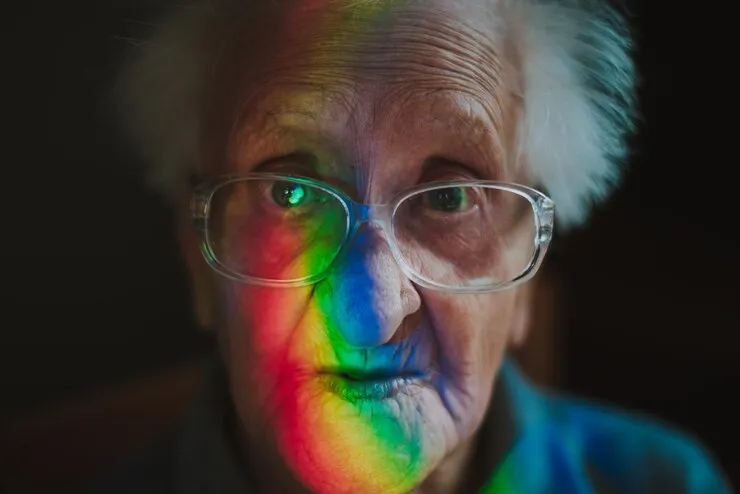
At The Rainbow’s End
Watching with my family, I was angry, tearful, and really mortified to be part of a society and a sector that can treat people like this. I found myself almost completely unable to explain why this sort of bullying and abuse can happen anywhere, let alone in services that are meant to support us to lead the kind of lives we want to lead. People in the audience talked so openly about the battles they’d had to win and the progress they thought we’d made, while expressing concern about recent backlash and genuine fear for the future.
We talked through some of what we’ve learned about how trends in broader society influence what happens in health and social care and why bad things can happen in settings where we’re supposed to be safe, as well as the importance of developments like direct payments in helping us have a greater sense of choice and control over our lives. We also touched on developments like co-housing, the work of charities like Ageing without Children, the need for values-based recruitment and the passion for social justice that some young people might bring if we find ways to help them be passionate about careers in social care.
More generally, a colleague at the University of Birmingham has led research on social care for older LGBTQ+ people and for younger people, and served as Chair of the international Sexuality in Social Work interest group. My IMPACT colleague, Sebastian Buser, is working with Newham Council to enhance the skills and knowledge of social care staff when supporting LGBTQ+ residents. There are more details on the IMPACT website, and a series of outputs, products and resources are on their way – but he’s been exploring ways to help practitioners create safe spaces in which people can talk about their identities, the things that really matter to them and the people who are central to them. At IMPACT, we believe that good care isn’t about ‘services’, but having a life – and approaches that don’t start with who people are and what matters to them isn’t really ‘care’ at all.
Sebastian is currently working on a series of resident stories, which are being illustrated by an LGBTQ+ Newham resident, in a graphic narrative style; a statement during assessments to help people feel more comfortable talking about their identities; and some conversation starters and prompts to help practitioners who might sometimes be too scared of ‘getting it wrong’ to open up the right kind of conversations. In particular, he’s been using a series of ‘personas’ – fictitious but realistic characters who might approach these issues in particular ways. This feels an important way of helping people to think about their own practice and behaviours, without feeling too uncomfortable about being asked to reflect directly on themselves and potentially closing up.
Please watch this space for more information – and please look at Clare’s work as a poignant and devastating way of understanding more about what needs to change.