As October, and thus Black History Month, comes to a close, we have been reflecting on the anti-racist practice work going on right across IMPACT.
IMPACT Network
In 2024-25, we ran a Network on anti-racist practice and strengthening inclusion. Members included British Association of Social Workers (BASW), Rethink Mental Illness, Cina Aissa, Chilypep, BASW NI, Scottish Association of Social Workers (SASW) and BASW Cymru. Networks explored the levels in which change was needed: systemic, organisational and cultural/interpersonal.
Goodwin Development Trust
One of the outputs from the Network included an event in Hull, delivered in partnership with the Goodwin Development Trust. We shared some key practice principles in a blog about the event, as well as a video on the key work and learning from the area:
Rethink Mental Illness
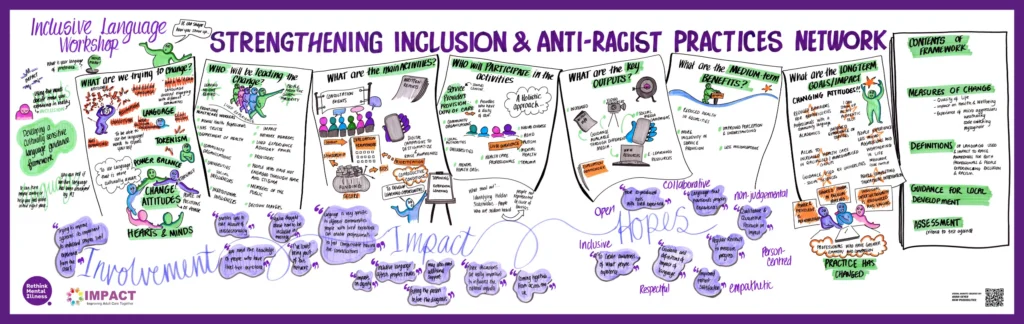
Rethink Mental Illness’ Network on Strengthening Inclusion & Anti-Racist Practices brought together Experts by Experience from global majority communities alongside Rethink staff to explore how mental health care systems can become more inclusive and anti-racist. Through a series of discussions, members shared experiences, reflected on evidence and research, and identified the ways that language can shape how people are understood, treated and supported. The Network highlighted the harm caused by overly simplistic, homogenising and culturally insensitive language when seeking support from mental health systems and providers. These insights informed the co-production of an outline framework for culturally sensitive language in mental health services, alongside a video diary capturing members’ reflections and learning from our co-production workshop. Together, these outputs aim to support staff and organisations to use more inclusive language and contribute to more equitable experiences for people from racialised communities.
BASW Webinar
Earlier this month, we delivered a professional learning webinar with BASW on learning from that IMPACT. The session explored how social workers can translate anti-racist principles into everyday practice and build stronger relationships with diverse communities.
Delivered by Suzie Crowter, Lived Experience Engagement Lead and National Embedding Manager at IMPACT and Cina Aissa, IMPACT Network Co-ordinator and Lived Experience Participation expert, the session drew on learning from research, lived experience, policy, and practice to highlight what effective anti-racist social work looks like in action.
They explored the realities of how racism shows up within social work, both for people who access social care and racialised practitioners who work within it. It was a valuable learning opportunity for social workers seeking to strengthen culturally competent practice, understand their legal and professional responsibilities, challenge systemic inequalities, and develop practical tools to build trust and improve outcomes for the communities they support.
The recording is only available to BASW members, but you can find the slides here.
Anti-racism Co-production Group
Last August, we put together a co-production group of six people, including racialised people and allies, to develop training around anti-racism and co-production.
The group has developed a board game to communicate learning from Isaac Samuel’s report, for which 36 people who are racialised and involved in co-production were interviewed, and our Network on anti-racist practice and strengthening inclusion.
The interactive game, Mind the Gap: Anti-racist Co-production, was developed from the Centre for Care’s Mind the Gap: Tackling Digital Exclusion game. This version was designed to help people explore how racism, power, privilege and organisational practice can shape people’s experiences of co-production. We hope the game will help people to:
- recognise how racism and unequal power can show up within co-production;
- understand that simply inviting diverse people into a space does not automatically mean power is being shared;
- explore how structures and practices can create barriers to participation;
- recognise the emotional labour that radicalised people can be expected to carry;
- think about intersectionality;
- consider what psychologically safer and more equitable co-production looks like; and
- identify practical actions they can take to make co-production more anti-racist.
The game will be launched at the Commissioners Conference in mid-November, but we welcome people contacting us about the game and training before then.