Encouraging young people to develop careers in social care
Project Background
This Facilitator project with Borderlinks aims to show young people what this career choice could entail and the enjoyment they could get from it, along with breaking down some of the stereotypes and myths surrounding work in social care.
This will be achieved by working with the people who use their services, and their staff and volunteers to create ways to engage young people in their project activities, and through outreach work within schools and other community services and groups. This project is based in Berwick, England.
IMPACT Factfile
- Year: 2025 – 2026
- Delivery Model: Facilitator
- Four Nations: England
- Themes:
- Resources:
Project Engagement
The first three months of the project have been spent speaking to as many people as possible working in the care sector or drawing on care in the Berwick-upon-Tweed area. As part of this exercise, Terri has visited a number of the Border Links groups in Berwick, Amble, Duns, and Kelso (towns across north Northumberland and the Scottish Borders). They have been incredibly welcoming, and their members have had some very thoughtful things to say about carers, helpers, or enablers. Those who took part in the conversations mentioned their staff should be kind, take an interest in them, and have the energy to take part in the activities that they’re interested in. Conversely, they could not imagine why anyone would not want to work with them.
Border Links staff took part in an online survey which asked why they chose a career in social care and what might make the sector less attractive to young people. Those who replied stated that they enjoyed the chance to use their teaching skills, they enjoyed watching Border Links members become more confident and grow as individuals, and that the hours and locations of groups suited them. However, staff could see that a lack of experience of working with adults with learning disabilities, long hours, and low pay could discourage young people from pursuing a career in social care.
Terri also handed out a number of postcards which contained survey questions.
The next steps of the project will involve:
- Engaging with members in workshops to further explore what they value in the people who support them.
- Supporting a group of members to coproduce a video to promote working in social care.
- Running a focus group comprised of young people, employers, and employability projects and government and local government staff as a first step in planning for a summer event showcasing social care careers.
Video Workshops
One of the project outputs is a video that will be used to recruit young people into social care careers. Although I was unsure if a video would be effective for encouraging young people, I soon changed my mind after meeting the Border Links’ Thursday group in Kelso, where the mention of a video caught group members’ imaginations. I also discovered the group were experienced in making videos, having previously made one when campaigning for their venue to stay open.
The group facilitator and I discussed the idea of video workshopping and decided on a series of six workshop sessions. Another worker also offered to write and record an original song for the video.
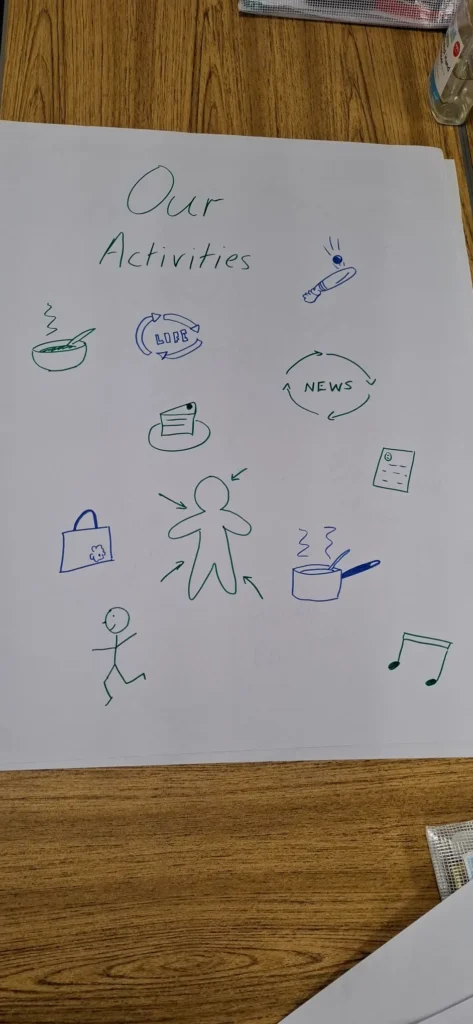
Members take part in many activities and have a wide variety of skills and interest. At the first workshop session, we planned what we would do to create the video, discussing the purpose of the video, the music, and equipment we can use to make it. The group also agreed to record the song as a musical-style number. We agreed we would try to use clips from members’ favourite songs throughout the video. After the workshop, I transferred the notes I made onto flip chart paper so that we can use these notes to produce a storyboard for the video in our next workshop session.
The second video workshop with the Border Links’ Kelso group proved to be as much fun as the first one. During this second workshop, we used the mood boards completed during the first workshop to develop notes to create a storyboard for the video.
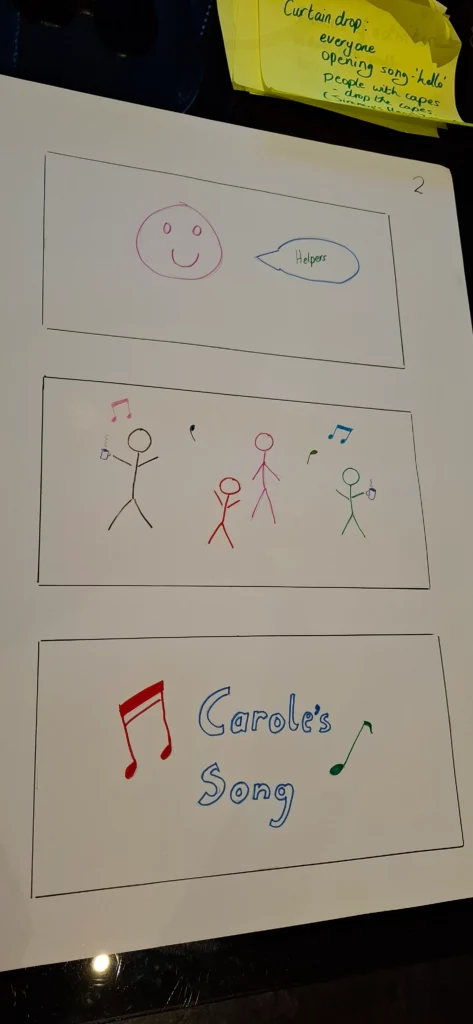
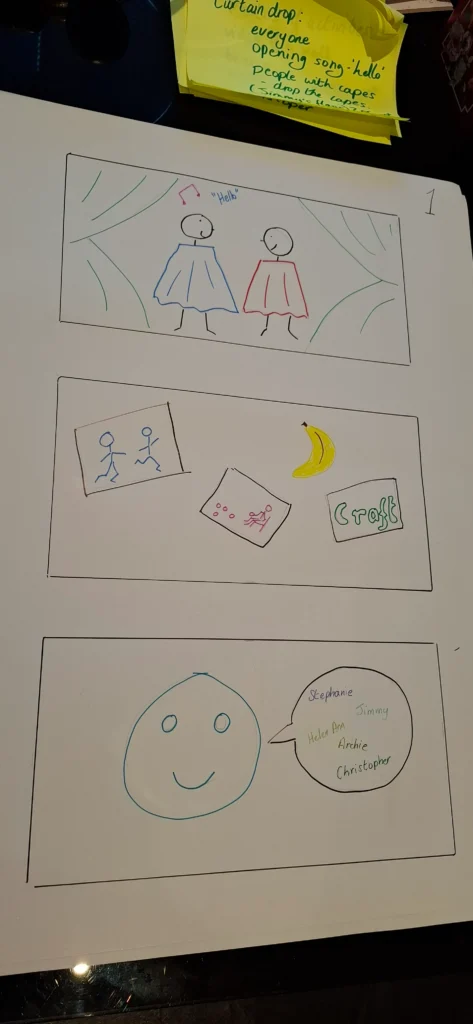
Six panels were used in the storyboard, which includes interviews with members of the group, footage of the group’s Sip ‘n’ Sing events, and the closing musical number. Sip ‘n’ Sing is a monthly event with tea, singing, and dancing, which the group welcome all to attend. During the workshop, we decided that some members of the group will wear capes in the video’s opening sequence and that we would try to include clips of the types of activities members of the group enjoy participating in. The group were also introduced to some of the songs that a member of staff wrote for them – one of which includes the refrain, “Hoots, ma boots!”
After the workshop, I drew up the storyboard. I then took it back to show it to the group members the following week at our third video workshop. As the group had been practicing their singing between workshops, in the third workshop we focused on using musical instruments and producing the choreography and script for the video. Group members were allocated specific roles for producing the video. We also decided on the questions we would use during the video’s interview sequence.
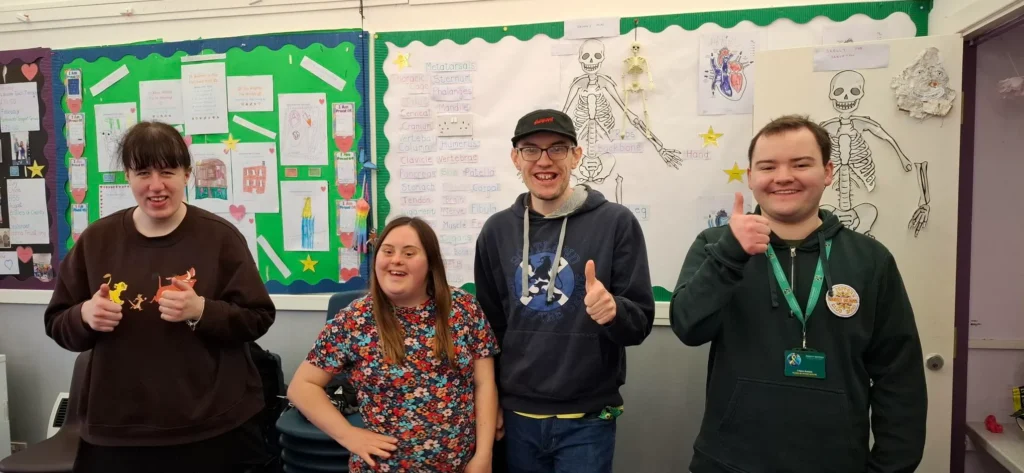
Meet Our Facilitator: Terri Bearhope
