Citizen leadership
Project background
When a community wants to shape its local services, the way they are involved can change everything. But for too long, that involvement has been reduced to a checklist: an invitation to a pre-planned meeting, a rigid agenda created entirely by professionals, and a seat at the back of the room with no real power to speak, lead, or make decisions. This approach means community support and social care are done for people, not with them, leaving local residents with little room to share their actual lived experience or build the equal partnerships needed to create lasting change.
This topic area brought together Networks to explore “citizen leadership”, with a view to moving away from the dominant, top-down model of public services where community engagement is treated as a box-ticking exercise. However, the sheer dominance of this traditional approach in local authorities suggests that it is not easy to move away from. It is an attractive model for organisations because it keeps control in the hands of professionals and fits neatly into familiar habits. But this rigid way of working must be seen within the context of increasingly squeezed budgets and deeply complex community challenges, where doing what has always been done is simply no longer working.
Pioneering examples like The Wigan Deal have proven that shifting the culture to trust local assets and share power is not an impossible dream. By treating citizens as equal leaders co-producing meeting agendas, sharing the microphone, and investing in grassroots capacity, they achieved healthier communities, higher staff engagement, and significant financial savings.
IMPACT Factfile
- Year: 2025 – 2026
- Delivery Model: Networks
- Themes:
- Resources:
Network members
Networks are meeting across the UK, coordinated by:
Cohort 1
Cohort 2
Evidence review
The involvement of people in decision-making has grown in recent decades, which has mirrored the growth in policy and legislation focused on people’s rights. The review evidenced that being a citizen leader requires specific skills, which can be supported through training programmes, but equally those working with citizen leaders need support and training to understand the role and how it will impact on their own working practices.
New ways of looking at leadership were also highlighted in the review, such as collaborative leadership. Understanding what makes a good leader is crucial to enable shared ownership and responsibility between citizen leaders and those who traditionally held power within services.
Recruitment needs a good understanding of what motivates people to become citizen leaders, and the evidence highlighted the importance of an accurate title for the position (which may not be ‘citizen leader).
The review found benefits from the inclusion of citizen leaders, and that while there may be some financial outlay for instigating citizen leaders into service developments, reviews, and planning (for example for recruitment and training), there are small, cost-less changes that can impact on including citizen leaders.


Meeting 1: Engaging with the evidence and sharing new learning
Across the first meetings, the Networks explored what citizen leadership means in practice and how it differs from involvement, participation and co-production.
A strong message was that citizen leadership is not just about having a voice, joining a meeting or being consulted. It is about people having real influence over decisions that affect their lives, communities, services and systems. Networks also highlighted that citizen leadership is often long-term, relational and collective, rather than a one-off role or activity.
- Language matters: some people found the term “citizen leader” unclear, formal or potentially excluding. Networks discussed the need for language that feels
- accessible, human and meaningful.
- Power and influence: Networks wanted clearer conversations about power, decision-making and accountability, not just involvement.
- Moving beyond tokenism: people may be invited to share their experiences, but this does not always mean they are heard or able to shape what happens next.
- Inclusion and accessibility: practical, communication, cultural and digital barriers can stop people taking part. Networks emphasised that people need different ways to contribute.
- Support and training: citizen leadership requires time, funding, confidence-building, peer support and training for both citizen leaders and the organisations they work with.
- Systems and culture change: Networks agreed that responsibility should not sit only with individuals. Organisations and services also need to change how they work, share power and build relationships.
These early discussions helped shape the next stage of the Networks, where members began developing local action plans for change.
Meetings 2 and 3: What the Networks highlighted
Across meetings 2 and 3, many Network members were already familiar with co-production, but citizen leadership was a newer and less familiar idea. Some Networks continued earlier discussions around whether the words “citizen” and “leader” were the right language. Others suggested alternatives such as “lived experience leader” or “community leader”.
However, the Networks expressed a shared view that citizen leadership is about people
having real influence over decisions, services and systems. It is not just about being consulted, joining a meeting, or sharing personal experience without anything changing.
Networks also highlighted the need to move beyond tokenistic involvement. People may be invited to share their experiences, but this does not always mean they influence what happens next.
Several Networks explored what needs to be in place for citizen leadership to work well. This included accessible information, payment and support for people’s time, training and development, peer support, trauma-informed practice, and safe spaces where people can contribute in different ways.
A key message was that citizen leadership is not only about supporting individuals to
become more confident. It is also about changing systems, cultures and relationships so that people with lived experience, carers and communities can genuinely shape decisions.
How citizen leadership relates to co-production
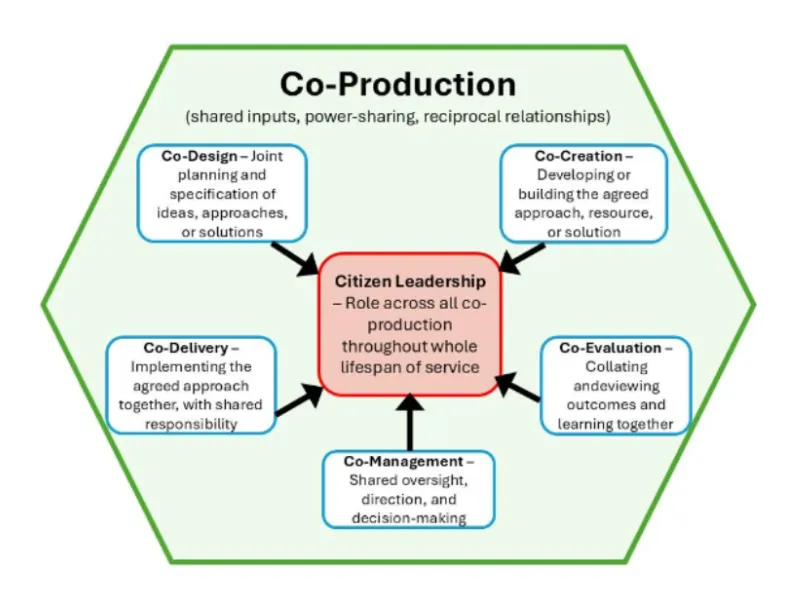
This diagram was created in response to questions raised by the Networks. It shows citizen leadership as part of co-production, but not as a one-off activity. Citizen leadership can bring together co-design, co-delivery, co-management, co-creation and co-evaluation. It is often longer-term and is about people with lived experience, carers and communities having an ongoing role in shaping change.
Curators of Change: understanding citizen leadership
Curators of Change used a community reporting approach to explore what citizen leadership means to people with lived experience and how it relates to co-production. Their short video montage brings together different reflections on citizen leadership. It offers one perspective on how power, influence and decision-making can be shared in practice.
Meeting 4 – What Networks are hoping to do (final action plans of what the Networks are doing next)
Each local Network developed an action plan for change. These action plans reflected local priorities, membership and context, but several shared themes emerged across the Networks.
To make the learning easier to explore, the action plans have been grouped into five broad areas.
Networks involved: People First; Rethink
Some Networks focused on creating practical resources to help organisations, professionals and communities understand citizen leadership and put it into practice. This included training materials, accessible resources, role descriptions, engagement guidance, and examples of good practice.
“What is meaningful to us are actions, not words.”
These action plans aim to support more meaningful involvement, reduce tokenism, and help organisations understand what people with lived experience need in order to lead, influence and take part.
Networks involved: Legacy Foundation; Conwy Connect / Wales Mental Health and Wellbeing Forum
Some Networks focused on making citizen leadership more visible through stories, case studies, short films and digital content. These action plans aim to show the impact of citizen leadership in real life, amplify community voices, and reach wider audiences, including decision-makers, organisations, local communities and young people.
“Words we use should reflect what they actually are.”
Networks involved: Centre for Independent Living NI; In Control Partnerships
Some Networks focused on influencing policy, standards, governance and accountability.
“People are happy to listen… but nothing is ever acted on.”
These action plans explored how people with lived experience can have a stronger role in shaping care standards, influencing policy, assessing quality, and holding organisations and systems to account.
Networks involved: Changes Plus; Public Engagement Agency; Reading Council; One Newham
Several Networks focused on local models that bring together services, communities and organisations around people’s lives. These action plans included ideas such as community hubs, citizen panels, integrated working, better signposting, community outreach, and stronger local collaboration. They aim to improve access to support and create more citizen-led approaches to service development.
“There is no such thing as one size fits all.”
Networks involved: Curators of Change
One of the strongest messages across the Networks was that citizen leadership depends on culture change, not just new processes or resources.
“Citizen leadership is not about getting people to speak louder – it’s about redesigning the environment.”
Some action plans focused on creating spaces where practitioners, citizens and organisations can reflect together, challenge traditional ways of working, build trust, and move towards more equal relationships.