Project Background
Across the UK, there is growing recognition that the people who rely on services – and those who care for them – bring essential knowledge that can transform how support is designed and delivered. From local councils to national public bodies, there is a clear shift toward involving people with lived experience and carers in commissioning and decision-making. This is not just good practice; it is key to building systems that genuinely help people live their best lives.
The IMPACT Network (September 2024 – March 2025) was created in response to this momentum. It brought together partners, practitioners, and people with lived experience from across all four UK nations to explore how meaningful involvement can be embedded in real-world decision-making. The Network provided a space to share ideas, test approaches, and learn from each other about what does and doesn’t work when it comes to inclusive practice.
There are many ways to involve people in shaping services. Some approaches, such as peer research and co-design, place lived experience at the heart of creating solutions. Others, like participation in committees, working groups, or consultations, offer opportunities to influence decisions at different stages. Each method represents a different level of involvement, from being consulted to actively leading change.
The Network focused on understanding these approaches in practice – examining how they are used, the value they bring, and the challenges they present. By connecting diverse voices and experiences, the project aimed to strengthen the role of lived experience in shaping more responsive, effective, and person-centred support systems across the UK.
Ultimately, this work is about more than participation. It is about shifting power, building trust, and ensuring that decisions are informed by the people they affect most.
IMPACT Fact file
- Year: 2024 – 2025
- Delivery Model: Networks
- Themes:
- Resources:
- Discussion Materials (PDF / Easy-Read Word)
Network members
Networks were co-ordinated by:
Networks in England
The Association for Real Change (ARC) is a forward thinking national charity supporting providers of Learning Disability and Autism services, and through a range of projects and services, people with a learning disability, autism, or other additional support needs, and their families.
Changes Plus Ltd involves its associate members with lived experience at the heart of contributing to educating healthcare professionals.
Camden Council is the local authority for the London Borough of Camden. It provides services like housing, social services, and education, with a focus on addressing inequality and sustainability through its “We Make Camden” campaign.

Disability Sheffield aims to help disabled people make decisions about their lives and support them to live in the community.

Northamptonshire Carers exists to make a positive change to carers’ lives. To do this, they reach out to, value and champion all carers and those they look after.
Networks in Wales
Networks in Scotland
Jo Clough is currently a Senior Research Associate, working on the ConnectED project at the University of Bristol. Jo is interested in co-production, intersectionality, and qualitative research with autistic adults, particularly women, non-binary, gender-expansive and LGBTQ+ folks.
Thera Trust seeks to demonstrate that people with a learning disability can be leaders in society.
Networks in Northern Ireland
Digital Health and Care NI (DHCNI) is the data and technology lead for the health and social care system in Northern Ireland. Their mission is to harness the power of digital to improve health and care for our population while improving working practices for all HSC staff.
Parent Action seeks to empower the parent carers of children, young people and adults with additional needs/disabilities to speak up or advocate for their family members’ needs in all vital public services in NI.
Evidence review
Each Network starts with an evidence review conducted by the IMPACT team:
Evidence consistently shows that involving people with lived experience leads to better, more person-centred services, improved satisfaction, and positive impacts on individuals’ wellbeing, confidence, and sense of purpose. It also helps practitioners better understand real needs, resulting in more effective and responsive support.
However, not all involvement is equal. Approaches range from consultation to co-production, with the greatest impact seen where people share power and are involved throughout the full commissioning cycle – not just asking for feedback. Despite policy ambitions, truly meaningful involvement remains limited in practice.
The evidence highlights persistent barriers, including power imbalances, lack of resources and training, difficulties in paying and supporting participants, and the risk of tokenistic engagement. Without genuine commitment, involvement can undermine trust and discourage future participation.
Overall, meaningful co-production requires long-term investment, clear roles, fair recognition of contributions, and a shift in how decisions are made – placing people with lived experience at the centre rather than at the margins.
To read more about the evidence review, You can view or download the full document (PDF) and Easy Read version. These documents were used by the local Networks to spark discussion.
Policy context across the four nations
The evidence also highlighted a shared commitment to involving people with lived experience in shaping health and social care across the four UK nations. Policies increasingly recognise that services work best when they are designed with the people who use them.
In England, recent legislation and policy – such as the People at the Heart of Care white paper and the Health and Care Act – promote more collaborative approaches to commissioning. However, there is no single national model for how to involve people, meaning local areas take different approaches.
In Scotland, participation and human rights are central to policy, with co-production embedded in the integration of health and social care. While there is strong national ambition, how this is delivered can vary across the country.
In Wales, co-production is a core principle of the Social Services and Well-being Act. Clear guidance and frameworks support its implementation, making it one of the most structured approaches across the UK.
In Northern Ireland, co-production has been a stated priority for several years, with a focus on collaboration and service user involvement. However, wider system challenges have limited the pace of change.
The ladder of co-production
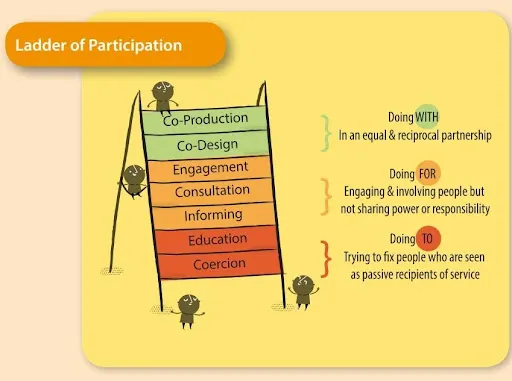
Not all involvement is the same. The evidence highlights a “ladder of participation” that shows how people with lived experience can be involved at different levels – ranging from passive roles to genuine partnership.
At the lower levels, people are simply informed or consulted. While this can gather useful insights, it does not involve sharing power or decision-making. In the middle, approaches like engagement or steering groups offer more involvement, but responsibility and control still largely sit with professionals.
At the top of the ladder is co-production. This is where people with lived experience work alongside professionals as equal partners, shaping priorities, designing services, and reviewing outcomes together. The strongest evidence shows that this level of involvement leads to the most meaningful and lasting change.
Moving up the ladder means shifting from “doing to” or “doing for” people towards “doing with”, where lived experience is valued as essential expertise in decision-making.
Key challenges in co-production
Local Networks identified recurring barriers for people with lived experience trying to influence care decisions. Co-production often happens too late, being used to test or refine services rather than shape them from the start. As one participant put it, “Sometimes it feels like it’s just a box-ticking exercise, as if the organisers have already made up their mind/decision.”
Access to information, local support, and advocacy is limited, making it harder for people to participate meaningfully. Practical barriers also play a role: “Sometimes, due to lack of support, I am unable to attend meetings in person.” Community spaces can help by enabling peer learning, training, and idea-sharing outside formal systems.
Co-production is also under-resourced. It requires time, funding, skill development, and fair compensation for participants. Accessibility remains a challenge, particularly for neurodivergent people and those with learning disabilities. As one person shared, “I can be quite shy, especially talking in a group, but others can talk forever, so I need support so that I have a voice for me.”
There is often a lack of clear roles, accountability, and national guidance. Feedback is not consistently acted on, and decision-making processes remain complex. This contributes to low trust in services, especially where lived experience is overlooked. Discrimination, stigma, and tokenism further limit participation, particularly for people from global majority communities.
At the same time, there is a strong desire to engage: “Candidates want to be involved and would like to see changes and/or improvements.” However, this requires a cultural shift, recognising that co-production is not always straightforward. As one Network reflected, “Accept it is messy. Embrace the mess!” while also acknowledging the need to “get the basics right”.
Where change could have the most impact
Co-production requires a shift in power. Networks highlight the importance of engaging decision-makers and those controlling local budgets to improve accountability and increase resources. Greater consistency in understanding and applying co-production principles would help raise standards across services. Improving communication and knowledge at a community level is also key – through better information, stronger support networks, and clearer guidance.
These are some examples of actions Networks have taken based on their discussions and action plans:
Changes Plus: This Network chose to focus on the following theme:
Co-production to enhance the delivery of health and social care in the community and the transition from hospital care to care in the community.
Read this blog to find out more.
Co-production is the way to go! So it’s just a question of how do we actually make that work, how do we get those values instilled and how do we get the information about good practice to the people who need to be following that good practice
Northamptonshire Carers: People and unpaid carers should be meaningfully involved in strategic decision-making processes in Northamptonshire, ensuring diverse voices shape policies and services by removing barriers, addressing accessibility gaps, and reaching underrepresented communities.
Camden Council: The group decided to focus on the Strategic Level of Co-production. This means that people with lived experience and residents of the council are involved in decisions that impact on the system such as policies, procedures and the assessment of practices. In particular, they identified communication, information, and advocacy as the main area for change. This includes improving the information and advice available on getting ‘early help’ in a crisis and getting help following a sudden change in health. Another area for change identified by this Network is the lack of local robust processes to share feedback, opinions, complaints and compliments. The group has continued to meet after the end of the Network. They have co-designed a step-by-step guide or visual aid to clarify support pathways.
Parent Action NI: There are over 300,000 parent carers of children with disabilities/additional needs in Northern Ireland (Census 2011; Contact UK 2017). Parent Action NI invited parent carers who had used Parent Action’s independent family advocacy service, Parent Action Connects Parent Action Connects – Parent Action NI, as well as local independent advocacy service providers and funders/commissioners of independent advocacy services in Northern Ireland, to join the Access independent Advocacy Network Northern Ireland (AiANNI) Network.